Author: Dawson & Saanvikha

  • Why Should You Study Abroad: An Introduction!

    Why Should You Study Abroad: An Introduction!

    Studying abroad was hands-down probably one of the best decisions we made during college. Everyone always raves about how studying abroad changed their lives. This sounds like a cliche statement that doesn’t really say much about the experience. Although we agree that studying abroad was extremely influential in our personal and professional growth, we want to elaborate more on why and encourage all of you to take advantage of the opportunity while you still have the chance! It is a lot easier than you would think.

    Our Journey to Studying Abroad

    Between the two of us, we ended up studying abroad in Italy, England, and at LSE- across three different programs and over multiple semesters. Both of us entered college with different perspectives on the possibility of study abroad. Saanvikha knew when she chose UGA that she definitely wanted to study abroad, but she always imagined that she would choose a Spanish-speaking country and spend no more than a summer studying abroad (which turned out to be quite the opposite of what she did). Dawson, on the other hand, did not see himself studying abroad at the beginning, especially with his rigorous coursework and as an aspiring MD/PhD. More so, he was initially supposed to go to Oxford the summer after freshman year, but due to being a resident assistant, it conflicted with the schedule of training and he could not go. Nonetheless, he ended up studying abroad more than most other students during college by spending a summer at the London School of Economics after his sophomore year and doing a Maymester at Cortona, Italy and a semester at Oxford University (the last two with Saanvikha).

    Dawson decided to study abroad at the London School of Economics because of his interest in applying for the Marshall scholarship and the realization that if he did not go abroad over the summer, then he would not have the ability to later on. He knew he wanted an internship the summer of junior year, so it made sense to go abroad sophomore summer. LSE is not a partnership school with UGA, nor with most schools in general, so he chose this opportunity as a way to meet friends in a more relaxed, English-speaking environment. Because of his economics degree, he was able to knock out two of the upper-level required classes abroad.

    As Biochemistry & Molecular Biology majors (or STEM majors in general,  it can often be hard to study abroad due to the specific course requirements and the course schedule. The Science and Art History Maymester, however, is targeted at giving Biochem majors the opportunity to get the experience of being abroad while completing an elective that goes directly toward the major. Getting away from UGA for a whole semester was a little bit more difficult for us. We started the process almost a year prior to the Oxford program with another one of our close friends, Widener, by communicating with our Biochem advisor, department head, and program director. Since we would have to take Human Biochemistry (one of the hardest major courses that is also only offered in the fall) at Oxford and Physical Biochemistry (another required courses), we had to get the course approved by our department, and the program director had to find a professor at Oxford that was willing to teach the course. Thankfully, our efforts ended up paying off, and the course was approved!

    Study Abroad Memories

    London School of Economics

    The London School of Economics and Political Science (LSE) is in the heart of London. Whether exploring Piccadilly Circus and the West End, eating across Soho, going shopping at Harrods and buying Vejas at Selfridges, eating chocolate-covered strawberries in Borough market, or having afternoon tea in Covent Garden, there was so much to explore. What was unique, however, was getting to meet friends and people from across the world and even the United States. Some of Dawson’s closest friends from the trip are at the University of Alabama and UNC, but he also met a number of people from Australia, France, and Spain. The true cross-cultural aspect of the program through interaction with people from across the world is amazing. The program itself was rigorous with 5 hours of instruction a day, and there was a fair amount of time spent in the library preparing for tests and projects. Dawson also got to go to Paris for the first-time as well as Lake Como. Although the program was a short two months, it sparked an interest in studying abroad in the future as well as finding ways to possibly live abroad one day.

    Cortona

    Cortona is probably one of the most beautiful and peaceful towns we have ever been to. The quaint little town is home to spectacular landscaping, rich history, inspiring art, and, of course, incredible food. In the heart of Tuscany (the MOST beautiful place), we were lucky to do this program with some of our best friends, so it was an easy adjustment and constant fun. Some of the highlights for us included eating two Michelin meals (the beginning of our food adventures! Although it is much cheaper abroad…), traveling to Florence, Siena, and Rome, multiple sweet treats a day, seeing the School of Athens in person, celebrating Dawson’s 21st birthday in Florence, eating the best gelato, and spending hours talking at night. Dawson also went to an F1 race in Imola and Cinque Terre for his birthday! Eating authentic Italian food was delicious, and having a morning cappuccino and afternoon sandwich was always a highlight. Despite having to share a bathroom with 7 other people or being in lecture for 8 hours a day and cramming for exams, it was one of the best months ever, and Dawson already has inspiration from Tuscany’s landscape for his future house.  

    Oxford

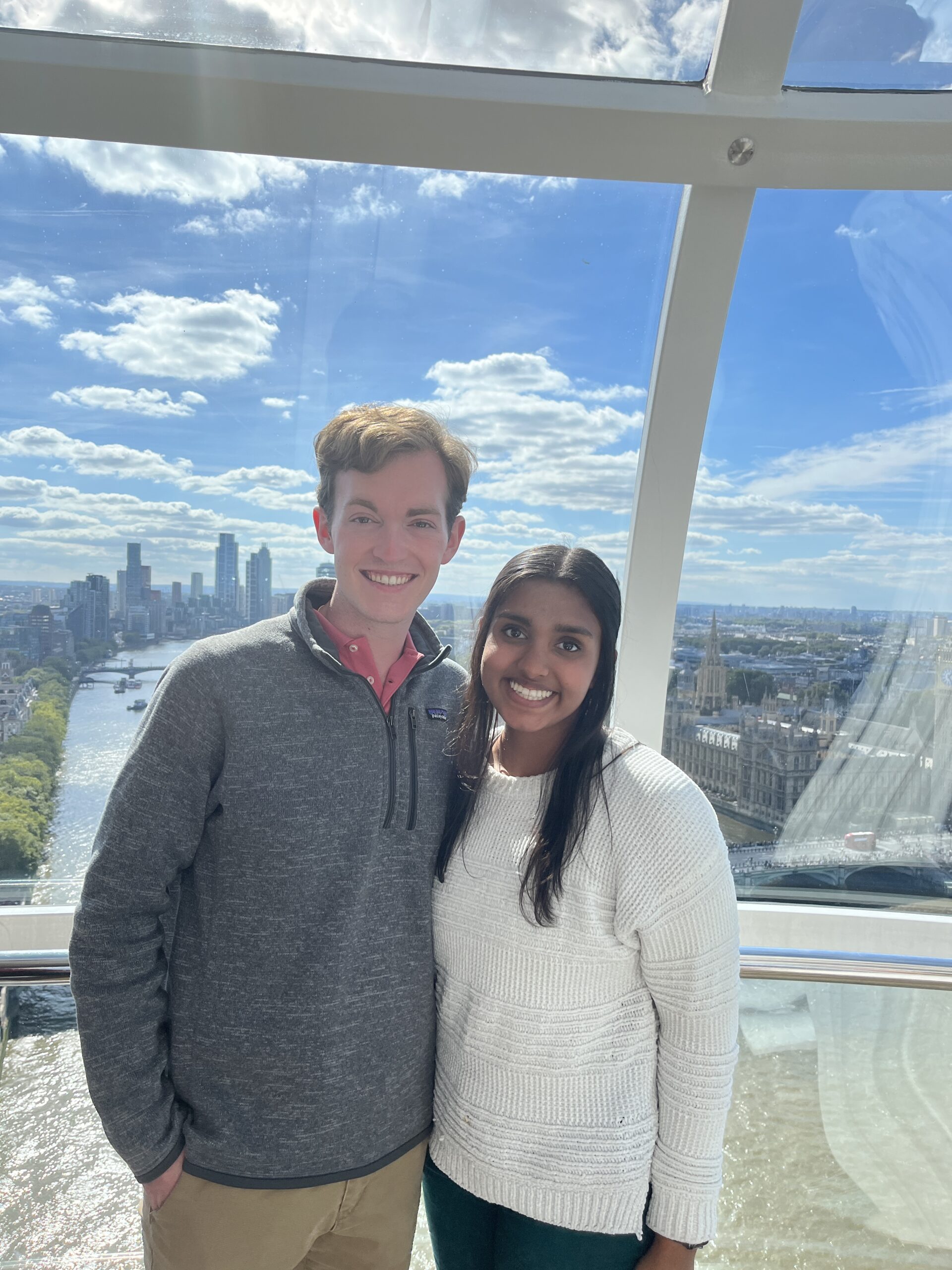
    Four months after Cortona, we were back at the airport to leave for our semester abroad at Oxford. Before classes started, we traveled with two amazing friends, Widener and Maggie (our Peppa squad!), to Edinburgh and Belfast. We cannot say enough good things about Edinburgh – the city holds a special place in each of our hearts. Classes in Oxford are far from easy, but the structure makes it manageable to still have plenty of fun. It is commonly known that Oxford is one of the most prestigious universities in the entire world, and the idea of being able to take classes there, engage with tutors, and collaborate with Oxford students was absolutely surreal. Oxford challenges you to think critically, understand the material presented to you rather than simply memorizing it, and learn to be receptive to more direct criticism. In Oxford, we went to Oxford Union debates (discussing if America is failing democracy), played on the club soccer team at Keble College, explored the museums, had high tea, and attended evensongs. We also got to explore the food scene of Oxford, see Christ Church meadows and the many gardens, and also traveled to Cambridge, York, Stratford-upon-Avon, Canterbury, Dover, the Cotswolds, London, and more. Over the weekends, we went to the Dolomites in Italy, Paris, Belgium, Colmar, Switzerland, and more! We miss our house of 42 everyday and the movie nights in the TV room together, long nights writing essays in the library, cooking meals in the kitchen, or simply talking in the foyer for hours. Luckily, our Oxford cohort is exceptionally good at staying in touch and reuniting at birthday parties even in Athens.

    Why should you study abroad?

    Studying abroad taught us so much about global dynamics, lifestyles and cultures in different parts of the world, and new perspectives. We made friends from around the world that we still keep in touch with who have deeply influenced how we view the world. It also impacted our future endeavors. Dawson sees himself living and working abroad for a period of his life, and Cortona and Oxford solidified Saanvikha’s desire to work in international health policy (got to see the WHO headquarters in Geneva!). 

    College can also force you into a bubble and a rhythm that can be hard to break from. Most of us, especially by the second semester of junior year, have found a steady group of friends and routine of extracurriculars and classes. By the time it was time to study abroad at Oxford, both of us desperately needed a break from our lifestyles at UGA and in Athens. We were burnt out and feeling frustrated. Studying abroad gave us an escape and gave us the opportunity to challenge ourselves and forced us outside of the Athens bubble that we had grown to become comfortable in. Even if all of you don’t feel the same way, at least some of you can relate to this feeling. Having the ability to explore the world, especially when you are not tied up in a job, is an incredible experience- even if balancing classes in the process.

    The next part is a little more UGA-specific. Don’t let finances and money hold you back from studying abroad because UGA is extremely supportive in making study abroad possible for everyone. There are tons of scholarships available, both program-specific and not – it’s all about talking to people and digging to find the opportunities. From Honors International Scholarship Program, Office of Global Engagement, Experiential Learning, to Foundation Incentive Scholarships, UGA encourages students taking advantage of the study abroad programs. Many students are even able to ‘profit’ some money to help pay for expenses of food or travel not covered by the program fee. Also, for out-of-state students, studying abroad is usually cheaper than staying in Athens since you pay in-state tuition while studying abroad through a UGA program. Both of us were able to have our Cortona and Oxford programs mostly or fully covered. You shouldn’t have to go into debt to study abroad. Reach out to us if you want to hear more about scholarships and financial opportunities!

    Find programs that interest you and don’t be afraid to explore a new country or part of the world. You are never going to be in your early 20s again with the freedom to travel and study around the world. Regardless of how stressful college feels, for most of us, we are only going to have more responsibilities in the future. I know it can be scary to leave friendships behind for a semester, miss out on a football season, or pause involvement. But, we cannot stress enough that all of these things will be here even when you get back. After Oxford, we were able to pick up friendships as they were before and still make the most of our last semester in Athens. You also shouldn’t be too worried about not being able to apply for grad programs or jobs while abroad. Most recruiters and admissions offices are very understanding about being abroad. In fact, Saanvikha did her second round BCG interview while in Scotland in a random coffee shop and ended up getting an offer! These experiences are wonderful opportunities to talk about how you stand out as you offer a new take on the world. So, take the risk and study abroad! You won’t regret it.
  • A Guide to Your 2025 Bingo Card

    A Guide to Your 2025 Bingo Card

    How we made our and why you should make one


    The start of the New Year brings a variety of trends: resolutions, 75 hard, new gym-goers, dry January, TikTok dances, vision boards, and more. When we first saw the vision board building trend (obviously on TikTok), we were a little skeptical. In theory, the idea seemed like a great way to set goals and create an aesthetic for 2025, but whether it was a Pinterest board or a physical board, it felt a little impersonal. Usually, people choose Pinterest pictures or quotes that resonate with them to curate their own board, but we wanted to take it a step further by combining some of our resolutions and aspirations for the year and turning it into a fun challenge. That’s when we stumbled upon the idea of a bingo card for the year.


    What is a 2025 Bingo card?
    A 2025 Bingo card consists of 25 (well, 24 with the free space in the middle) goals or milestones we want to hit before the end of the year. The idea behind the bingo card was to choose goals that were challenging so that we wouldn’t be able to easily get a bingo. We pulled ideas from our resolutions list or even just the different trips or personal development goals we had for ourselves that came up in conversation. Throughout the year, we want to complete and cross off as many of the different squares as possible with the aim of hitting a bingo (or better yet, a blackout!). Now that you know what the concept of the bingo card is in case you haven’t seen it before, we’re going to try to convince you to make one.

    Why should you make one?
    We know it’s already been 3 months into the year, but it’s never too late to set goals and work towards creating the best version of yourselves. In college or busy work lives, it can be easy to fall into a rhythm and routine that is hard to break out of. With the constant pressure of deadlines and packed Google Calendars, students and young professionals tend to neglect personal care and growth. How many times have you noticed yourself struggling to list off your hobbies or interests when someone asked you? Or, think back to the last time you were able to truly take a chunk out of your day regularly to read, bake, or meditate simply for yourself? We noticed that setting short-term and long-term goals (not necessarily related to professional accomplishments), helped us focus on our hobbies and intentionally carve out time in our day for ourselves. You cannot be successful and happy professionally if your mental health or self care is suffering or not your #1 priority. A bingo card is something that constantly reminds you about your goals as you can physically create and have it in your room or desk. Also, most of us are fairly competitive and high-achieving, so the idea of crossing off as many of the boxes is enticing and motivating in itself. If nothing else, making one is something fun and cheap you can do with friends to hang out and bond (give your bank accounts a break from the overpriced coffees or extravagant meals)! Since we hope you are convinced, we will break down step-by-step how you can make your own bingo card.

    Building it Out

    1. Make a list of 24 goals (keep a good mix of personal growth, professional accomplishments, and other random things you want to do)
      • Trips you want to take
      • Any big purchases you want to make
      • Job changes
      • School milestones (graduation, internships, transfer)
      • Fitness goals
      • Personal goals (learning something or getting a certification)
    2. Grab a piece of paper and your favorite craft supplies (part of making a Bingo card is making it actually look good)
    3. Create a 5 by 5 square grid on a piece of white paper
    4. Make the middle square a free space or an easy milestone
      • We put celebrating our 22nd/23rd birthdays
    5. Lay out the other goals in the remaining squares 
      • Try to make it so it is actually difficult to get a Bingo
      • You can use Chat to help lay it out even
    6. Decorate it as you want and make it your own
    7. Hang up your bingo card somewhere you will see daily!

    A glimpse into our Bingo Cards

    If you’re one of our close friends, you’ve probably heard us talking about our bingo cards before, but in case you haven’t, we’ll give you some inspiration as you make your own. We have a mix of everything on our bingo cards. Dawson (fully in his food and wine connoisseur era) wants to get his WSET 1 and 2 certifications and has some very ambitious goals for his Beli (check out our restaurant adventures blog here!). Saanvikha is already missing the travel era from 2024 and has trips like Nashville and national parks on her bingo card and is even trying to fly Delta One (which looks VERY unlikely). Also, she really has stayed strong on not wearing sweatpants to class all semester. We also have some similar goals on our respective cards from a Blue Ridge cabin trip, running an official half marathon, and reading a certain number of books by the end of the year.

    Believe it or not, we have already started crossing things off – a big one being starting this blog! We really hope all of you will consider making a Bingo card. Both of us have noticed a big change in our motivation and attention to our physical, mental, and emotional health. We spend more time actually doing our hobbies and pursuing our interests and have noticed a change in our overall personal care and happiness. If you do make one, send us pictures of your bingo cards if you make one and thanks for tuning in!

  • 10 Skills To Develop As An Undergrad

    10 Skills To Develop As An Undergrad

    Hi! Welcome to our first REAL blog post. If you missed our introduction, check out Meet Campus to Corporate to learn more about our background and why we started Campus to Corporate!

    We still clearly remember our first week at UGA when we were full of excitement and anxiety, unsure what the future held for us. Now, four years later, this campus has become our home. It has been a long arduous journey, but we wanted to share some skills we learned while in undergrad that we believe would be beneficial to your success. And, don’t worry, each of these will get their own spotlight in future posts.

    Between science classes, research, clubs, music, and dance, we threw ourselves into everything UGA has to offer. We added majors, switched career paths, got rejected from a lot of opportunities, made lifelong friends, and tried to leave a legacy on campus.  

    We learned a lot throughout college to say the least. Some of these skills we wish we had known before freshman year—like how to actually manage our time instead of running on three hours of sleep while working at the main library. Others, we only learned by the time we were about to graduate such as embracing uncertainty and building meaningful relationships beyond college. So, to help out anyone just starting or anyone looking to hit the reset button on their college experience, here are 10 skills that shaped our college experience. 

    This is just a quick overview, but in the coming weeks, we’ll be diving deep into each one with real stories, lessons learned the hard way, and practical takeaways. Let’s get into it!

    Drive – You are your biggest motivator! At the end of the day, only you can push yourself to go after the big opportunities and take the risks. We both have put ourselves out there for organizations and leadership roles that we thought we didn’t have the best background for but we cared and wanted to leave an impact which allowed us to grow. A large piece of advice is to simply set a goal for yourself, and then every semester lay out the 3-5 things you need to undertake to make that happen.

    Time Management – The biggest difference between high school and college is that no one structures your time for you, so it’s easy to struggle with overcommitment (constantly running on low sleep and way too much Starbucks shaken espressos). Learning to use tools such as Google Calendar, Google sheets, managing to-do lists in the notes app, and practicing saying no made the difference for us. 

    Reflection – The biggest growth happens when looking back thoughtfully rather than just always moving forward. This is a skill we learned much later in our college career but wish we started practicing earlier. The introspection that comes with reflection is crucial in our path of self-discovery. Through learning about what you value and why you value it, you can learn what career and opportunities are right for you so that you are placing your energy where you have the greatest impact on yourself and others.

    Prioritization – As much as we would like to have Hermione’s time turner and do everything, we simply can’t. Spreading ourselves too thin also prevents us from diving deeply into certain areas and creating change. This skill goes hand and hand with drive, find the 4-7 opportunities you want to invest your time in and hold that close to you. Whether that is hosting a book club, undertaking research, or playing in an intramural sport, there are many ways to get involved, build a resume, and simply enjoy college. But, do NOT just fill your time with activities you do not care about and cannot connect back to your “why.”

    Balancing Personal & Professional Aspirations – Aspiration is important to success, but even more importantly is identifying the opportunities you need to build skills or experiences in certain areas. Whether starting a blog to reflect, joining student government to make an impact, or being part of a dance team to continue a childhood passion, it is important to put yourself in many unique situations that allow you to grow in meaningful ways that benefit YOU. Not everyone needs to pursue *cough cough do not tell our PI’s* research, but it can help you build time management, knowledge in a unique discipline, and learn how to interact and present your work to people smarter than you. The trick is to find what makes you excited. 

    Being Open to Ambiguity and Change – College is ambiguity101, navigating difficulty, and adjusting to life beyond high school. One of the biggest lessons we learned is that there’s no single, predefined path to success. It’s easy to assume that when you pick a major, you’re locked into a specific career (like being a doctor), but, we’ve seen biology majors go into consulting, finance majors pursue social impact work, and art students become surgeons. Careers evolve, and new opportunities constantly arise, arguably many of which you won’t even know exist until you’re a few years in. Don’t limit yourself without seeing what experiences are available to you. Be willing to pivot, take risks, and explore opportunities outside of your initial plan. 

    Giving Back – Arguably, giving back is a fundamental skill, and in working in development, we have always been told of the three t’s: time, talent, or treasure. Use your talent or background in a meaningful way by investing in or mentoring others. I know as college students without a steady income it can be hard, but even writing a check and donating $10 a month is a way to be impactful without breaking the bank. We love working with and mentoring underclassmen because we went through the exact same struggles and existential crises when we were in their shoes. Our commitment for giving back stems from the huge investment former upperclassmen put into us.

    Building Friendships & Community – Gosh. College would simply not be what it is without the many friendships we have made along the way. Our biggest piece of advice? Make time for them. Know who is there for you, and be there for them too. Maybe you will have a night where you have a lot of work to do and a close friend asks you to go play pool because it is their birthday. Maybe it’s not the wisest thing to do, but know that those around you are the most important assets that you have. So, make time for them. It’s all about showing up when it matters most. And remember, that true friends will also show up for you time and time again. If they care, they will. 

    Dealing with Imposter Syndrome – We cannot even begin to tell all of you how much we have been rejected- from an organization, scholarship, opportunity- and thought the world was going to end. The feeling sucks. The ‘sophomore slump,’ was truly a difficult time. However, everything that is meant to be will come for you, and know that there are millions of more opportunities ahead. So, keep pushing and applying for all the opportunities that align with your interests. Also, there’s no point in comparing yourself to the person next to you because 99% of the time you are not even competing against those in your immediate circle. For example, our 4-person biochemistry-major squad has one going into consulting, one interested in pursuing law school, one going to medical school, and one taking a gap year also interested in clinical medicine. The only thing you have control over is yourself, so focus on improving yourself and your work.

    Understanding Personal Finance – Roth IRA this, Vanguard that, or 529 talk. Yeah, it seems slightly foreign and intimidating, but personal finance is so important. Helping others understand how to be financially responsible has been a large goal for Dawson (null of the too frequently eating out). Understanding how to invest even $50 a month in index funds or having no debt is largely important in success and preparing yourself for the future.

    These topics will be broken down and analyzed in many more posts to come, but we wanted to offer an initial overview on what we believe are 10 of the most important skills to build during your time as an undergrad and as you turn into your next opportunity in life. You may find that many of these skills overlap, and they do! Most importantly is understanding how to best prepare yourself for the future. If you have specific questions on any of these skills or how to apply them to your own lives, don’t hesitate to reach out!

  • Meet Campus to Corporate

    Meet Campus to Corporate

    January 21, 2025

    Hello and welcome to Campus to Corporate!

    We’re so excited to have you join us as we navigate this big transition from college life to full-time jobs after graduation in May. Whether you’re getting ready to start college, currently pulling all-nighters for school, stepping into the world of 9-to-5s, or simply going through a milestone transition in your life, this blog is your go-to space for relatable advice, fun laughs, and a whole lot of reflection.

    So, what’s Campus to Corporate all about and why should you read what we have to say? This blog started as an idea over one of the many random texts we sent to each other as we reflected on our past existential crises about our future and chaotic college lives. We realized we weren’t alone in navigating these big transitions, and that’s how Campus to Corporate was born—our way of sharing the laughs, lessons, and the ‘figuring-it-out’ moments. Simply put, it’s about the journey—the highs, the lows, and all the experiences in-betweens. Whether you’re balancing 19 credit hours with 2 a.m. Cookout runs or figuring out what to do after graduation, we’ve got you covered. We hope to share tips, tricks, and personal stories that resonate with you, no matter where you are on your path. 

    To make the most of Campus to Corporate, we (Dawson and Saanvikha, your trusty co-founders) have broken it down into five key themes that reflect the journey. Here’s what you can expect to see:

    1. Campus Adventures: Think undergrad survival guide—everything from academic struggles, building lifelong friendships, studying abroad, conducting research, and extracurricular opportunities while in school. We’ve been through it all whether it was consistently being in the library until 4 AM or curating senior year bucket lists.
    2. Corporate Beginnings: Ever wondered what starting a “big boy/girl job” feels like? We’ll talk about navigating the workforce, chasing career goals, and embracing those “What do I even put on my LinkedIn?” moments. This section will also give a glimpse into the world of the diverse careers and opportunities out there. 
    3. Life in Motion: “Balance” is a word you hear an unnecessary amount of times in college, but what does it entail and how do you even achieve it? Find out how we continue to figure out what balance is to us with stories about personal growth, hobbies, and work-life transitions during and after college. 
    4. Food & Fun: Because what’s life without good (and with us, usually expensive) food and unforgettable memories? From hidden gems on campus to bougie eats in the corporate world, and of course our favorite travel spots and weekend adventures! 
    5. Money & Milestones: The finance talk is one some of us might dread. A 401K, Roth IRA, this all feels like a random string of letters and numbers that you know are supposedly important but you have no idea what they mean. This will be our platform to talk about finances, budgeting, and also celebrating big wins and milestones for us.

    What’s the mission here at Campus to Corporate? To inspire, inform, and entertain. This blog was born out of a joint desire to share our lives. Whether you’re here for the tips, the laughs, to read our failures, or just to see us attempt to “adult” (whatever that means), we’re thrilled to have you. 

    No matter what field you’re in: science, business, arts, or anything in between, or wherever you are in your journey, we’re here to make this space as relatable and inclusive as possible. As our close friends know, we LOVE to talk (usually too much). If you have ideas, questions, or topics you’d like us to explore, please reach out! 

    We hope to grow, adapt, and expand this blog in whatever way is most helpful and interesting to all of you. This is as much your journey as it is ours, and we can’t wait to build this community with you. Also, shameless plug, for the latest updates, behind-the-scenes moments, and even sneak peeks into future posts follow us on Instagram @camptocorpblog!

    So, grab your coffee, boba, tea, Alani, (or for Dawson, lemon water), and let’s get to it. Stay tuned–it’s going to be a fun ride with us on Campus to Corporate!