As interview season comes up (actually, does interview season ever end?), we wanted to write about how to tackle the behavioral portion of an interview. Since this is part of the consulting series, we will give some consulting-specific behavioral tips, but also the following advice is widely applicable whether you are applying to grad school, an internship, or even to be a barista at your local coffee shop, so keep reading!
Why does this portion of the interview matter?
More and more applicants underestimate the behavioral portion of a case interview. We work so hard for case prep and in making sure we master the technical skills that we forget to focus on the behavioral questions. We would argue that the behaviorals are sometimes more important. Although Bain doesn’t usually do behavioral questions, they are the minority amongst consulting firms. In a world where a majority of applicants are starting to master the motions of running through a case and are simply varying degrees of good, the behavioral can make or break an offer. It’s the only chance for the interviewer to get a sense of who you are, what matters to you, how you work, and how resilient you are. And let us tell you, as we dive deeper into this job, we can’t stress enough the importance of working with good, personable, hard-working people. So how do you actually “master” the behavioral?
Behaviorals are unique, and they can be scary. But don’t stress! At the end of the day, the interviewer just wants to get to know you. So, as you read through this, think about, “What do I want the interviewer to know about me?” Of course, your answers should tie back to the broader position you’re applying for and you should highlight relevant skills.
Remember, the experiences don’t matter- you don’t need to talk about consulting internships or prestigious experiences. What is important is how you tell the story. What was important, what did you do, and what did you learn? The STAR method: situation, task, action, and result is a good starting place, but, honestly, that is just a starting framework to structure your thoughts. It’s good to structure your thoughts but you want to avoid your answers from sounding too formulaic or rehearsed.
Let’s dive in to how you prepare for the questions!
Having completed interviews for consulting firms, scholarships, research positions, and school clubs, we can confirm that although the questions in each interview are different, the preparation is quite similar. Here is a piece of advice that really changed our mindset on how to approach an interview: if they don’t remember anything else, what are the three things you want the interviewer to remember about you? Every single one of your answers should directly tie to those three things you listed. They can be quite generic or as specific as you want. For example, it could be that you want the interviewer to remember your ambition to solve problems, or it could be your empathy and ability to build deep relationships with all the people you touch. Ideally, the takeaways should be something that ties to the position or job description you’re applying for, or it should leave a mark on the interviewer. If the interviewer had a rubric for the job posting, think about how you can tie your experiences to match that rubric. That’s another key part of how they remember you amongst the slew of people they’re meeting on a given day.
Next, I would recommend writing/typing out 4 stories or experiences that resonate with you. For me, these were experiences in my research lab, studying abroad in Cortona/Oxford, public service and policy work through The Backpack Project of Athens/API, and my interest in health law through my summer internship. Write as much as possible at first about these experiences, touching on specific situations where you showed resilience or encountered failure. Be specific.
The interviewers will dig for details and it’s better to be more specific up front then scramble to remember details in the middle of an interview. In my McKinsey interview, I would often start off by (1) describing my story at a very high level and (2) checking with the interviewer if that was a good experience for the specific question they were asking before diving into the details. I think that’s a very McKinsey-specific tactic and is something their interviewers recommended doing.
Once you have these stories written, the hard part is out of that way. You can basically adapt the stories to fit almost any question you’re going to be asked. People often ask me what organizations and clubs I participated in to prepare me to be a consultant. The honest answer is there is no organization that fully prepares you to be a consultant (lol). And the interviewers KNOW that. It’s okay if you weren’t in the business school clubs or the consulting clubs at your school. I was pretty far removed from it. The behavioral is all about how you can speak about your experiences and show how they have prepared you to succeed in the role. For consulting, they really are looking for ambition, curiosity, problem-solving mindsets, work ethic, compassion, personality, and collaboration. So focus on using the experiences you do have to highlight those sides of you.
Some consulting specific tips…we’ve noticed that nowadays behavioral questions are getting super specific. And each company is different: Bain reserves a maximum of about 5 minutes for behavioral during each round (sometimes less) with fairly straightforward questions, McKinsey is famous for their PEI which can be closer to 20-30 for EACH interview (but they also provide the questions ahead of time), and BCG falls somewhere in the middle with slightly more specific “tell me when” questions. Of course you should write a little ‘elevator pitch’ about who you are (this should be high-level as a story about you) with a brief background and why you want the job. But, remember, you should never actually call it an “elevator pitch” during the interview. And it’s likely that you won’t even be asked for it. Nonetheless, you should always be prepared for it because it is usually the first impression and sets the tone for the rest of the interview.
Now that you have your stories and pitch written…what’s next?
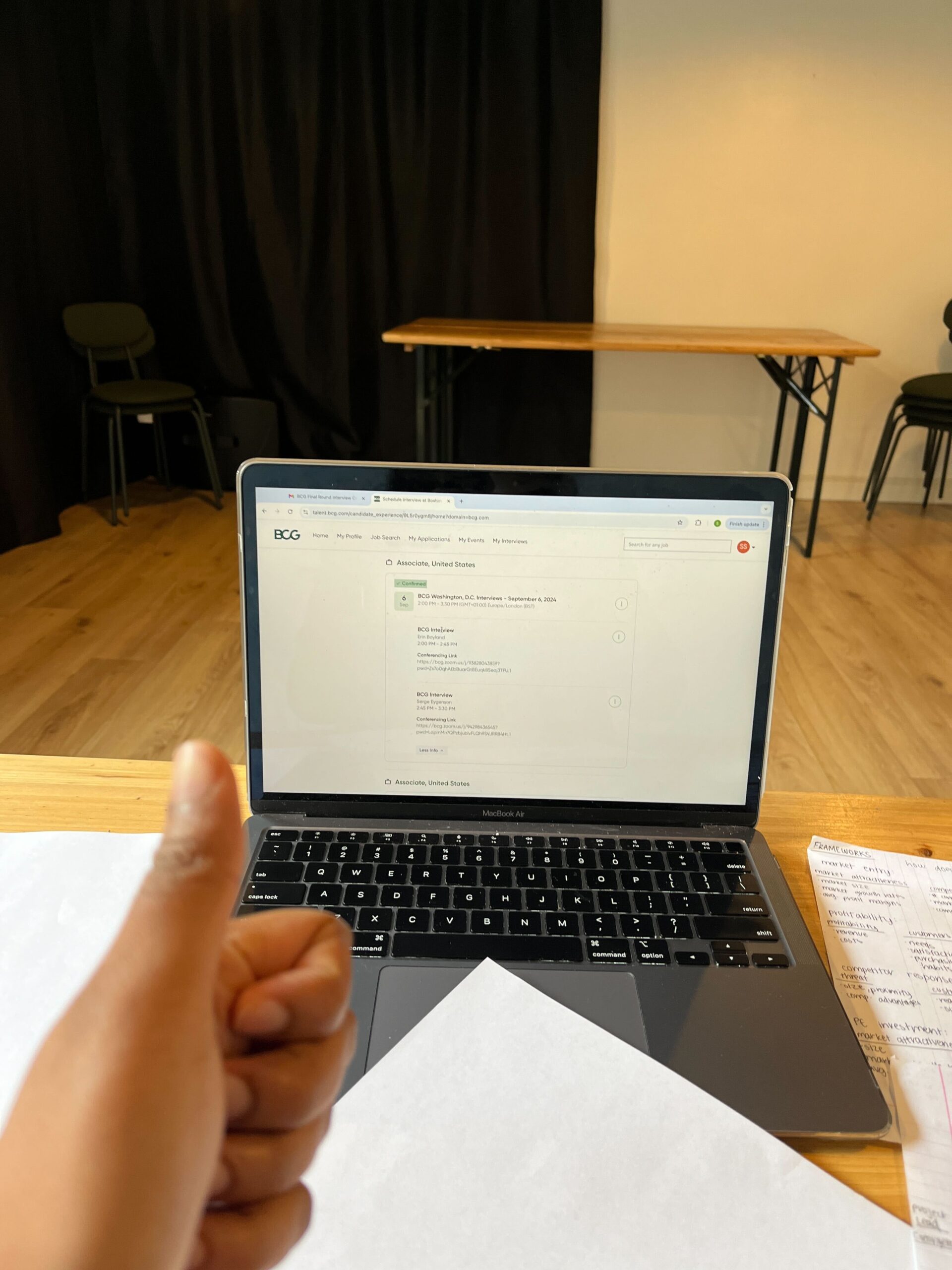
PRACTICE. You need to practice before your interview regardless of how prepared you think you are. You can literally stand in front of your mirror and practice saying your answers and talking through the stories. Since a lot of my recent interviews have been over zoom, I opened up zoom on my laptop and practiced talking to my laptop. Sometimes I would record myself to see where my eyes were moving and if I was using my hands too much. Interviewers notice the little mannerisms especially on zoom so it’s better if you catch them yourself first.
Another option is you can do something we call a ‘resume walk’ where you practice with your friends. This is where you have them ask you a question about literally anything on your resume and you should be able to defend it. Using this method, we were able to give feedback to each other on our articulation of the stories and also if the stories were good choices for the interview. Find a buddy and help each other. The more you stop viewing interviews as a competition, the better the results will be.
Last minute tip to save for the night before the interview…
I always recommend preparing for some ‘out-of-the-blue’ questions. These aren’t really “easy” to prepare for because the entire point of them is to throw you off, but if you even go in expecting to hear a weird question, you won’t be as stressed when it does come up. I’ve been asked things like if you were suddenly placed on Mars what is one book, influential person, and piece of art you would bring with you. Or even, what state best describes you? Weird, I know. But literally look up questions online or on Chat and there should be a crazy list that compiles that you can practice. The best way to prepare is to think about what the interviewer wants to know from you, and answer in a way that showcases your personality or ties to a niche interest. I wouldn’t spend too much time on this piece, which is why save this for the night before.
Well, we hope this is helpful for your next behavioral. If you have an interview coming up, you’re going to crush it! Believe in yourself and stay confident. Please reach out if you have any questions.