
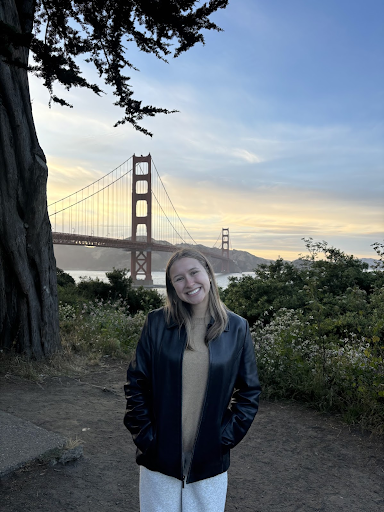
In this guest post, we are thrilled to introduce our wonderful friend and writer, Sam Dilley! We both met Sam during our sophomore years at UGA and simply cannot imagine college or life without her. Over the past few years, we have seen Sam intentionally create impact on campus, foster a community, and pursue her goals with conviction. Her dedication shines through her commitment to sustainability, global experiences, and involvement across campus. Beyond all of that, Sam is an incredible friend who is compassionate, silly, and so fun. Oftentimes when we’re facing a dilemma or trying to make a decision, we ask ourselves “What would Sam do?”. More often than not, we end up going straight to her for advice because she has great insight. One of the qualities we most admire in Sam is her ability to balance her personal, academic, and professional lives, which is why we asked her to share her approach here. Her tips are helpful no matter what stage of life you’re in, so keep reading!
Hi! My name’s Sam Dilley and I’m a recent graduate from UGA. I met Dawson and Saanvikha in my sophomore year when actually applying for a scholarship, and we’ve all been great friends since. I asked Dawson to get coffee as he was a family friend’s RA, and we talked all of winter break, of where I got to meet Saanvikha! While my path is a bit different from theirs, focusing more on corporate sustainability, we all have intersecting interests in economics, consulting, and policy.

In college, I majored in Ecology and Economics with a bunch of certificates and emphases focused on skills needed for the corporate world (leadership, data, sustainability consulting, etc.). With that, I had to balance all of these course requirements while seeking out opportunities that gave me knowledge and experience in my niche field. It took a lot of time management, networking, and intentional balance to create the time for everything I wanted to do. I’m going to be writing about balancing everything you want to do in college while setting yourself up for the future!
During my freshman year, I was overloaded with all of the commitments I had taken on. I joined a sorority, was the EcoRep for the community council, planned social events for my living community, was in Model UN, and started volunteering. It got to the point where I was having weekly breakdowns, and I had to drop commitments I had made, like conferences or volunteering. My boyfriend, Rohan, sat me down one night and told me about a method he had been using at Georgia Tech (yes, ew) to make sure he was balancing his time and being intentional about his commitments. I’ve been using it every semester since then and told all of my friends about it (hence Dawson and Saanvikha asking me to explain it to you guys!)
So, here’s the math:
5 days of classes = 120 hours
MINUS:
- Time spent in class (50/75 minutes added up and turned into hours)
- Time spent sleeping (I aimed for 8 hours/night)
- Time spent commuting/walking to and from class
- Time spent doing homework (8-11 hours/week for me)
- Time spent cooking, eating, doing chores, showering, getting ready (I did 10-15 hours)
- Time spent doing extracurriculars (changed by semester for me, but normally 5-10)
- Time spent on research/internship (2-10 for me depending on semester)
For example, this was my Fall 2024 calculator:
- AKPsi: 3 hours/week
- UGArden: 2 hours/week
- Classes: 10 hours/week
- Walking to class: 5.5 hours/week (I added up the hours per day)
- Homework: 11 hours/week
- Internship: 10 hours/week
- Chores: 2.5 hours/week
- Eating: 5 hours/week
- Showering/getting ready: 4 hours/week
- Sleeping: 40 hours/week
= 27 hours of free time
Rohan explained that the remaining number of free time hours you have should be close to 30 hours. ANY semester, when I was below 30 hours, I started to feel more stressed and had less time. And yes – 30 hours seemed like a lot, but even in my Fall 2024 calculator, I found that I started to skip UGArden much more because I needed the extra two hours per week. This time is really important to buffer for hanging out with friends, studying extra for an exam, or doing miscellaneous tasks/chores. For me, I really cared about being social during college, so I had a lot of plans during the week that definitely took up a large chunk of those 30 hours. But, this could change depending on where you’re at – I spent time applying to internships one semester and scholarships a different semester using some of that free time. Creating that free time for myself allowed me to go on a fully-funded study abroad to Germany and get an honorable mention on a national scholarship that helped me get into grad school


Having a set time limit really forced me to be intentional about what I was spending my time on and which opportunities would best prepare me for post-grad. When I had more opportunities than time, I had to look at which one I thought was most valuable for me and turn down others. I turned down research opportunities, stopped an internship sophomore year (I was working beyond my summer term), dropped my sorority, and stepped down as president of the Sustainable Business Society before my senior year to make time for what I cared about. Looking back, I don’t regret any of the decisions I made to free up more time for myself and have fun. But, beyond having fun, I also needed the self-motivation to think about my future. What did I want to do? How could I find a career in sustainability where I could make an impact and feel like I was helping the planet?
While it took a lot of self-motivation (and some of those 30 hours!) to seek out opportunities that allowed me to make that impact, having numbers and a stopping point was the most important thing for me to have intentional balance. It forced me to ground myself and think about what I wanted and how my involvement helped me to get there. It didn’t have to be completely focused on a career – AKPsi provided me with lifelong friends, and my internship gave me a chance to make a difference at UGA – but I did things that fulfilled me. And that same fulfillment focus applies to my career in sustainability. While many of my peers are going into research or nonprofit positions, I saw the corporate world as a space to make a difference. I found a job that allows me to help corporations, local governments, and higher education institutions claim tax credits and save money on their sustainability projects. Hearing my clients on calls, saying that they wouldn’t be able to reduce waste in manufacturing or take carbon out of the air without financial assistance, helps me to be at the forefront of changing an industry that doesn’t prioritize sustainability.
The key takeaways from this, as someone who found their own interest and path at UGA, is:
What fulfills you, and how can you make this time for your present and future self?
If you struggle to say no or set boundaries, it may be through your time calculator. Or, it may be intentionally journaling and making pros/cons lists of the opportunities in front of you. It may be you being brave enough to not continue your involvement in something the next year if you realize it doesn’t work for you anymore. But, college goes by in a flash – and you only have so much time to make the most of it. Be intentional about what you want to do with your life, while balancing who you are now and how to prepare for your future.
